

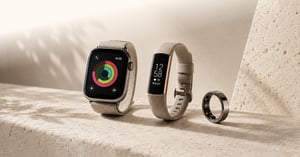
The best wearable? It depends on what you want it to do.
This article is for general informational purposes and isn't medical advice. For questions about your health, always speak with a licensed healthcare provider.
You probably open the app for your wearable after every workout: calories, heart rate zones, pace, another ring closed. That's the part everyone checks. It's also the smaller part of what the device is actually doing. The right wearable can help you better understand the other 23 hours.
A ring, watch, or band is tracking your resting heart rate, heart rate variability, skin temperature, breathing, movement, and sleep just as closely as it tracks your run, then turning all of it into something you can actually use: how recovered you are, how well you slept, how much your body is carrying on a given day.
None of this means watching every number in real time. The device tracks quietly in the background, and your part is checking the pattern every so often.
Your body keeps notes, even on the quiet days
A workout is easy to account for. You know when it started, when it ended, and how it felt. The rest of your life may not be as predictable. A travel day with almost no exercise can tax your body just as fast as a hard workout. A day at your desk, a tough conversation, too little movement, a late dinner, and you feel every bit of it by morning, even though nothing about the day seemed significant on paper.
Your wearable can help catch these changes. It may show that your resting heart rate is elevated after a flight or reveal how a late dinner or poor night of sleep affects the measures it tracks the next day. It may also flag when several measures have shifted from your usual baseline. That does not explain why they changed, but it can give you a reason to pay attention, prioritize rest and hydration, and speak with a licensed healthcare provider if the changes continue or you feel unwell.
When the numbers don't match how you feel
A complicated event takes place; sure, your stress must have spiked, and your device barely registered it. Or the opposite happens: you felt calm all day, and it tells you your body was working hard. That trips people up the first time it happens, so they think their wearable doesn’t work.
Neither reading is wrong; they're just picking up on different things. A wearable can't hear what was said or know why it affected you. It's reading physical signals, and those signals move for all kinds of reasons that have nothing to do with stress: heat, a bad night's sleep, dehydration, alcohol, even a big meal.
Not every wearable is doing the same job
Part of getting useful health information is picking the right wearable. They're not interchangeable—each one is built for a different job.
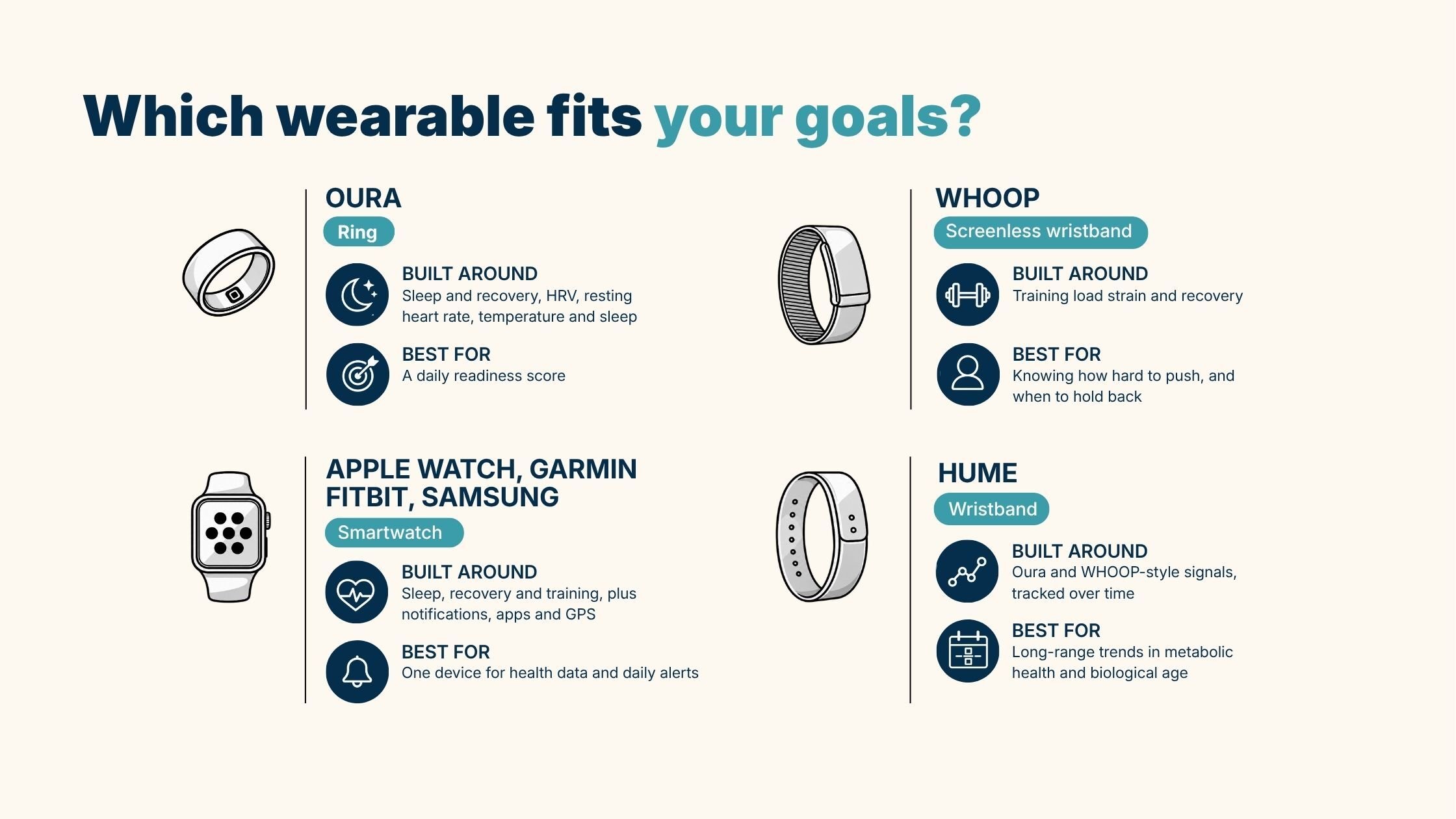
Worth knowing before you buy: those longer-range metabolic and biological-age claims don't yet have the kind of independent research behind them that something like resting heart rate does. Treat the numbers as a reason to pay attention, not a verdict. And of course, always consult with your physician on health-related concerns or questions.
What's actually worth watching
With all these signals available, the ones that matter are simpler than the dashboards make them look. Your resting heart rate trend over a few weeks tells you more than any single morning's number. Your HRV trend can add context about how your body is responding to stress and recovery over time. Sleep consistency, duration and quality can each help you understand how well you are resting. And there's a real, practical payoff to paying attention: people who get regular feedback from their device consistently end up moving more. One 2024 randomized controlled trial found that adults age 50 and older recorded 7% more physical activity on days when they received feedback from a wearable device.
The recovery or readiness score most devices generate is just those signals rolled into one number, and it's most useful for one specific thing: permission. Most of us don't need convincing to take it easier; we need permission. A low score on a day your body's been through something gives you permission to take it easy, even if you may have pushed through anyway. A strong score on a morning you feel behind may help you decide to keep your workout on your schedule.
If you're shopping for a wearable, here's what actually matters
If you're weighing whether to get one, or trade in the one you have, skip the spec sheet and start with how you actually want to interact with it. A ring or screenless band means no glancing at your wrist mid-meeting and no extra notifications, but also nothing in the moment: you check everything after the fact. A smartwatch puts more in front of you in real time, at the cost of another screen competing for your attention and, usually, shorter battery life.
Beyond that, check whether the accuracy you need matches what you're buying it for. Casual sleep and recovery tracking doesn't need lab-grade precision. Serious training benefits from a device built around workout metrics specifically, not just general wellness.
Also check the actual cost of ownership, because it varies more than people expect.
- WHOOP requires an active membership, so the subscription isn't optional.
- Oura is a one-time purchase for the ring itself, but the full app experience also runs on a membership model.
- Hume is closer to a straightforward one-time purchase, with a paid coaching tier as an optional extra rather than a requirement.
Know what it's good for, and what it's not
These are consumer devices, good at surfacing a pattern, not at telling you what a symptom means. That distinction matters most when fatigue won't quit, your heart rhythm feels off, or a sleep problem keeps going. Bring it to a licensed healthcare provider instead of trying to self-diagnose from the app.
Spend your health information well
You don't have to be an athlete to get something out of a wearable, and you don't have to change how you train to get more out of one you already own. Sometimes the payoff is small and specific: proof that the everyday choices you're already making are working, or a heads-up a day before you'd have noticed on your own.
At Impact, we believe your health should support your life, not run it. That's the idea behind Health, Well Spent: practical information to help you spend your time, attention, and money on what actually helps you live well.
A wearable earns its place when it helps you understand your body, make one useful change, and get back to living. Good healthcare is only part of that. What you do with it is the rest.
Impact Member Note: All of the wearable devices featured in this article, and their related subscription fees, are eligible for Impact’s Wellness Rewards program. Eligible members can submit receipts for qualifying health and wellness expenses to reduce their household’s annual Primary Responsibility Amount (PRA) by up to $150 per month.
Program rules and restrictions apply.
This content is for educational purposes. Impact is not affiliated with or sponsored by the wearable brands featured.
Source: Saw, H.-W., Kapteyn, A., & Darling, J. (2024). Does feedback from physical activity measurement devices influence physical activity? Evidence from a randomized controlled trial. Survey Research Methods, 18(3), 263–272. https://doi.org/10.18148/srm/2024.v18i3.8308


